ProbeLab's 2025 Review and 2026 Outlook
Happy 2026! It’s been a while since our last update here on our blog, but for a good reason! Apart from doing what we’re doing best, i.e., measurement, monitoring and optimisation of P2P protocols, we’ve spent the last few months of 2025 on a complete revamp of our website! We’ve rebuild everything from scratch to provide better experience to our users, more detail on all graphs and dashboards, plus a better view of historical data.
In this blogpost, we give a summary of our 2025 achievements and provide a summary of our targets for 2026.
Website Revamp
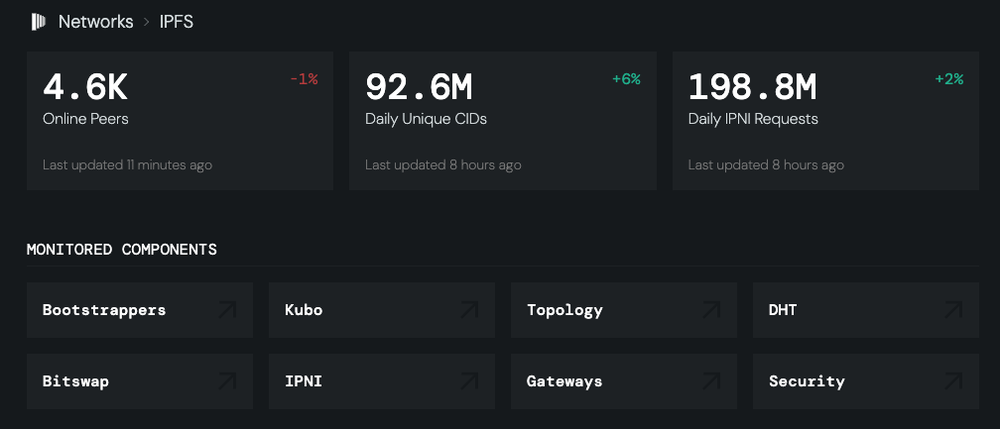
Here are some highlights on the website’s new features:
- The metrics presented are better grouped under the protocol they represent.
- The data presented can stretch back to the start of our monitoring deployments giving a nicer long-term evolution view of the results.
- The tooltip gives a lot more information than previously, with detailed percentage numbers.
- Where possible, there are drop-down menus to choose the desired client implementation, percentile, or geographic location and get more detailed information.
Check the new layout and dashboards at the well-known URL: https://probelab.io - as always, feedback and requests for more data/graphs are more than welcome.
New Networks Monitored
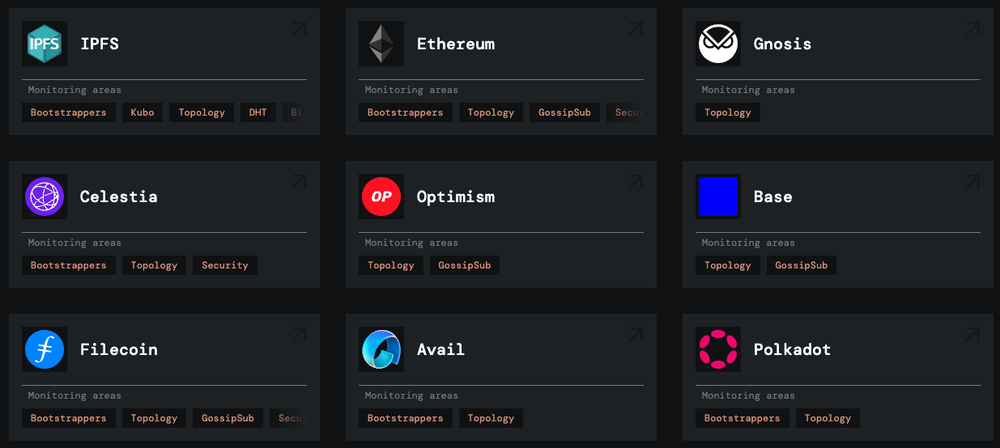
We’ve added several new networks to the list! Highlights here include:
- Metrics for the Gnosis network [link]. These metrics and the corresponding tooling come alongside and power much of the Gnosis team’s new dashboards: https://metrics.gnosischain.com/.
- Metrics for two of the most popular Ethereum L2s, in particular, Optimism [link] and Base [link]. The metrics include both general metrics and core statistics on node geo-distribution, protocols supported and cloud provider dependency, but also detailed metrics on the performance of the pubsub protocol, Gossipsub.
Overall, our portfolio now includes public metrics for 9 networks.
New Metrics for Existing Networks
Ethereum
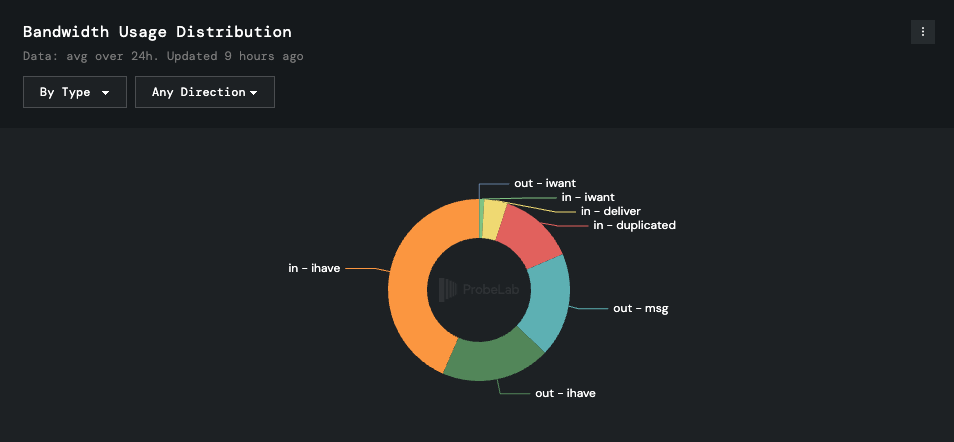
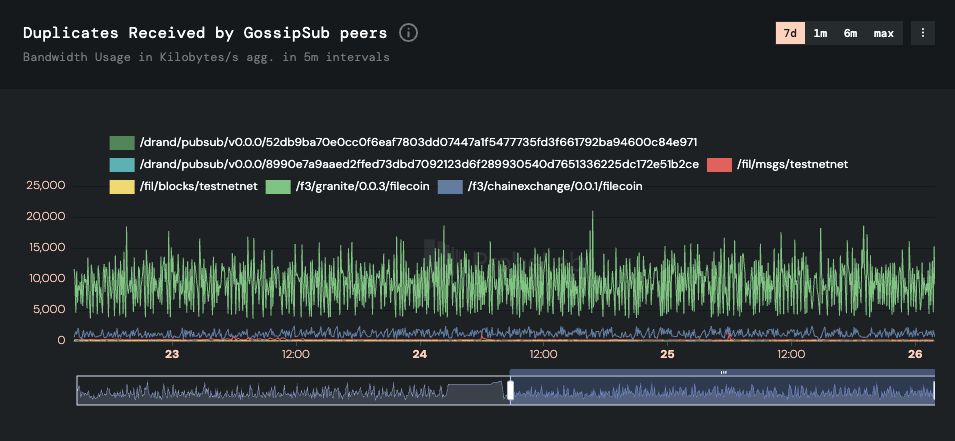
More detailed metrics for Ethereum Mainnet. We’ve enhanced the list of metrics we have for Ethereum and included dashboards and alerts for the discv4 and discv5 bootstrappers [link], detailed metrics on the performance of Gossipsub [link], including details on incoming and outgoing bandwidth consumption, as well as bandwidth consumption by message size, number of duplicate messages and block arrival times grouped by geographic distribution and agent type, among other metrics. Last, but not least, we’re now monitoring the “Keyspace Density” of the discv5 DHT [link].
IPFS
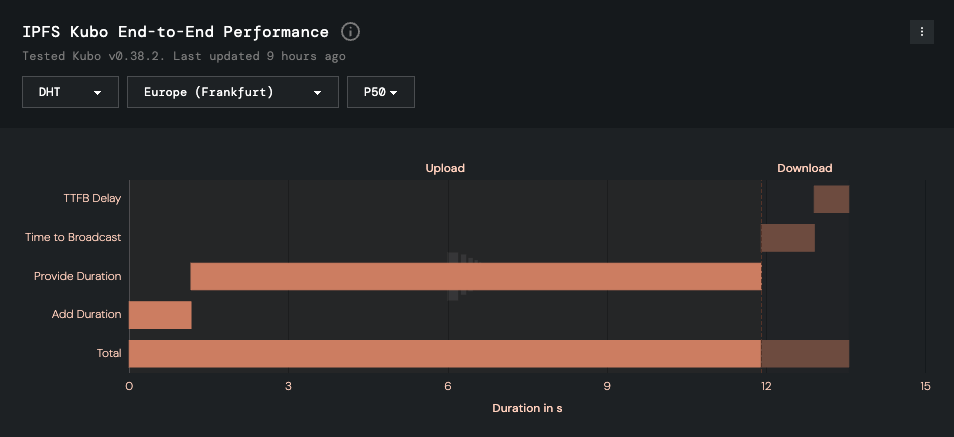
We’ve added several new metrics to our collection of metrics for IPFS. We now have a dedicated section on the performance of Kubo [link] including a new, very informative graph of Kubo’s End-to-End Performance [link].
We also have a dedicated section on the statistics and performance of the Bitswap protocol on the IPFS network [link], which includes, among others, the number of Daily Unique CIDs seen [link], the number of WANT requests [link], a list of the most active peers by count of the requests made and CID popularity in the network. These have been long-awaited results that the community and engineers were looking for for years.
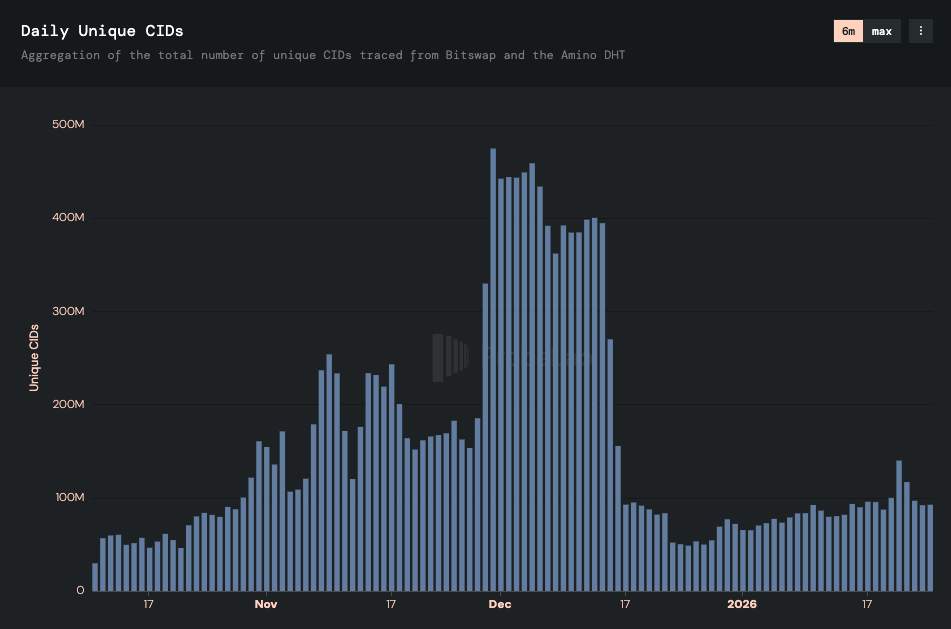
ProbeLab’s expertise and new tooling has made that possible! Another very impactful addition to our dashboards is the uptime of the cid.contact InterPlanetary Indexer [link]. The section includes several other metrics for IPNI that makes it easy to track the availability and performance of this critical piece of infrastructure.
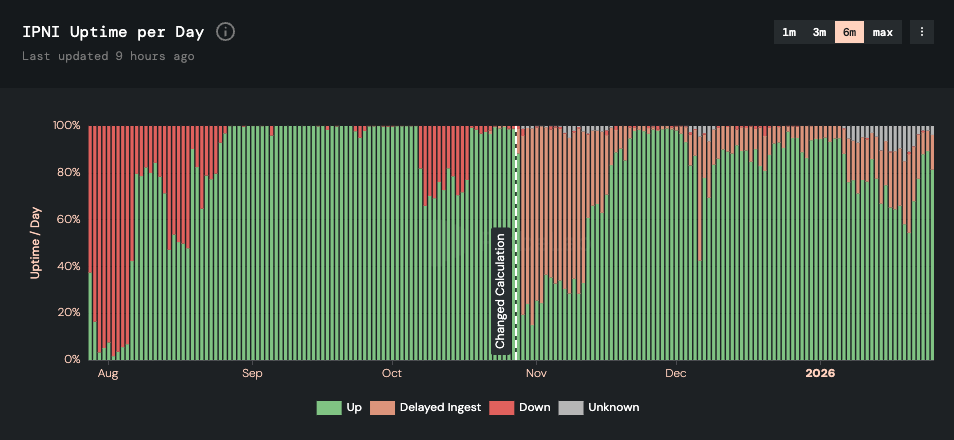
Filecoin
We have significantly expanded the range of data we present for Filecoin. One very critical addition is the data on message propagation through the pubsub network, over the Gossipsub protocol [link]. As with the case of Ethereum, in this section we include critical metrics about the health of the blockchain network at the networking layer, which indirectly confirms the “liveness” of the chain.
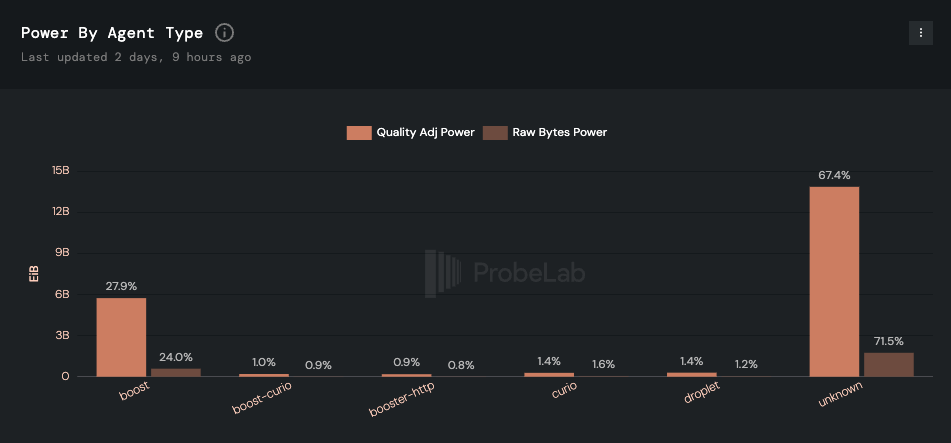
In addition to this, we are now deriving and presenting the “Power by Agent Type” [link], a very important metric that reveals diversity in terms of the power held by different client implementations.
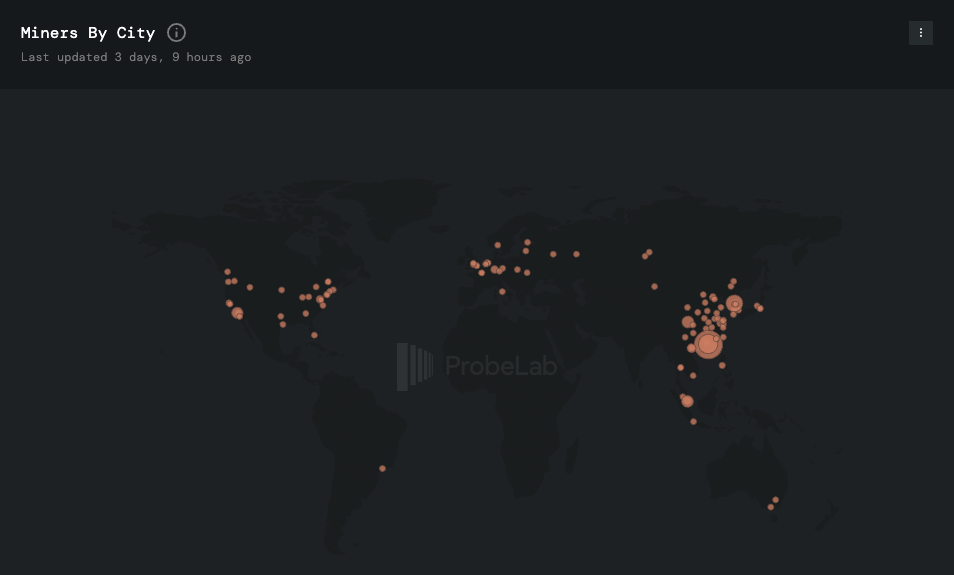
Finally, we have managed to map the Storage Providers by geographic location.
OP Superchain Composition
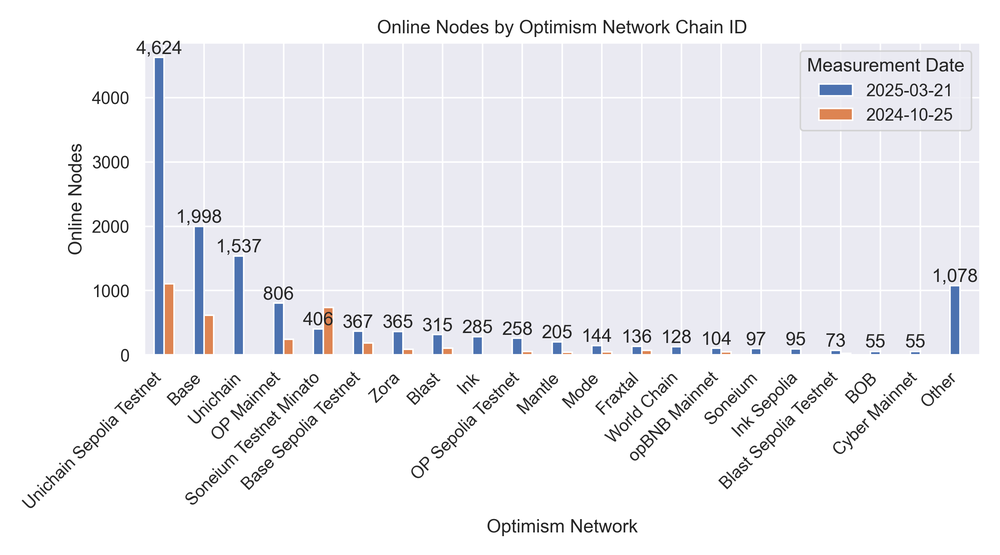
The OP Superchain has become one of the most popular L2s in the Ethereum ecosystem. Lots of projects build on top of Optimism to develop their solution. It has never been clear what the composition of the Superchain looked like, in terms of the number of nodes per L2. Although the study is already “old” (mid-March 2025) and we plan to repeat it again soon, the findings were eye-opening for several teams in the ecosystem. Read the full blogpost to find out all the details: https://probelab.io/blog/optimism-chain-composition-repeated/.
Toolset Updates
ProbeLab operates specialised infrastructure that runs 24/7. Our tools are developed with resilience and longevity in mind to minimise the time needed from our engineering team for fixes and maintenance. That said, we are regularly upgrading and extending our tools to support more networks and add more features. Here’s a summary of the new tools we’ve developed in 2025 and the extensions to our existing toolset.
Hermes
Hermes was originally developed to act as a lightweight node for the Ethereum network to track all networking traffic, but without the need to validate messages. Hermes enabled us to track the number of duplicate blocks in the network and several other important metrics for the Ethereum network - see ethresear.ch posts on: [Number of Duplicate Messages], and [Network Dynamicity].
In 2025, we’ve extended Hermes to support the Filecoin network, as well as Ethereum L2s, such as Base and Optimism. Having these results for Gossipsub increases significantly the confidence of node operators and the community at large.
Nebula
The most popular network crawler in the Web3 ecosystem, Nebula, now has added Clickhouse as another database backend; complementing Postgres and JSON. Given the wide adoption and use of Clickhouse for analytical workloads, this integration enables faster queries to answer typical questions that arise from the collected data.
Nebula also has added alpha support for Bitcoin and derivative networks like Litecoin, Bitcoin Cash, ZCash, or Dogecoin. Further, it has added first-class support for the Gnosis network and therefore Nebula powers ProbeLab’s Gnosis Network reports but also the Network metrics at: https://metrics.gnosischain.com/.
Ants
ProbeLab’s innovative tool that tracks the presence of DHT client nodes was developed in 2024, but, as of early 2025, it has been tracking metrics regarding the Light Nodes present in the Celestia network. Our tool was the first one to give visibility into this metric, which is very important for the Celestia ecosystem. Read more details at: https://probelab.io/blog/monitoring-celestia-light-nodes/.
In 2025, we’ve maintained and expanded the Ants, which now powers some of the data presented in Celenium’s dashboard.
Ethereum DAS Guardian
Last but not least, our team has developed eth-das-guardian [link], an experimental, semi-standalone utility for assessing data-column custody in the PeerDAS context. The tool logs and debugs all relevant information related to connecting to a remote node and verifying whether it retains and shares the data columns it claims custody of. The tool has proved extremely useful for the Ethereum ecosystem in the run up to the PeerDAS launch.
2026 Targets & Focus Areas
A lot can change within the course of a year and small, efficient teams like ours have to be flexible and adaptive in order to continue producing impactful results. Here, however, we’re providing a summary of the most important targets for our team, as well as the areas of particular interest.
Expanding the ProbeLab team
The Web3 ecosystem has matured significantly during 2025 and many teams have realised and appreciated the fact that the networking and P2P layer protocols play a significant role in blockchain systems. This realisation in the wider community has come together with several new requests for metrics and tailor-made studies. We are thankful to our customers and the projects that show trust and support to our services.
In order to service the requests and make Web3 networks faster, more resilient and optimised, we are expanding our team. We are grateful to the projects that have showed their support and trust to our services and we’re looking forward to work with many more.
Technical Focus Areas
Filecoin: The network has gone through a major upgrade, the Filecoin Fast Finality, or F3 for short. We’re currently working on setting up infrastructure and tooling to provide support for several critical metrics for the Filecoin F3 network. Among other metrics, we will soon be presenting the following metrics:
- Time it takes for an F3 instance to finalize.
- Distance of the latest F3 finalized tipset from the current chain head.
- Nodes participating in F3 relative to the network size in terms of agent version breakdown.
- Gossipsub efficiency in terms of bandwidth consumption, starting from number of duplicate messages and extending to other metrics.
The ETA for these metrics to start appearing on probelab.io is end of February.
libp2p Deep Dives: We have been collecting metrics for libp2p-based protocols for several years now. During those years we have seen what affects the operation of networks, when networks are healthy and when they are struggling to keep up with traffic and what is the best configuration for the several parameters of libp2p.
Using the knowledge and expertise we have acquired over the years we will be doing a full-fledged review of existing datasets over several libp2p-based networks. The outcome will be a series of detailed “best practices” guides with information on node and network configuration as well as what to pay particular attention to for good network health.
Security Audits: One of the long-standing quests within our team has been that of the resilience of current P2P setups and networks, or in other words, what does it take for an adversary to cause disruption. In 2026, we plan to put our expertise in practice in this domain too. Without, of course, affecting the good operation of live networks, we will emulate in real time how easy/difficult is it to eclipse nodes and censor content.
Looking forward to a productive 2026 with even more exciting and impactful metrics! As always, if you require assistance with P2P headaches, don’t hesitate to reach out to us.
Related Posts
Optimistic Provide: How We Made IPFS Content Publishing 10x Faster
How a statistical approach cut IPFS content publishing times by over one order of magnitude.

Behind the Scenes of Ethereum's Pectra Upgrade: A Data-Driven Analysis
The Pectra Upgrade in Numbers from the P2P Network.

Filecoin Network Health Weekly Reports are Live
Dive into Filecoin's DHT most important metrics.