Tor under DDoS, seen from the Bitcoin Network
Introduction
As of the 17th of October the ProbeLab team collects metrics about the Bitcoin network. The metrics comprise general topology information (e.g., where nodes reside geographically) but also specific data about nodes like their sync state and feature adoption.
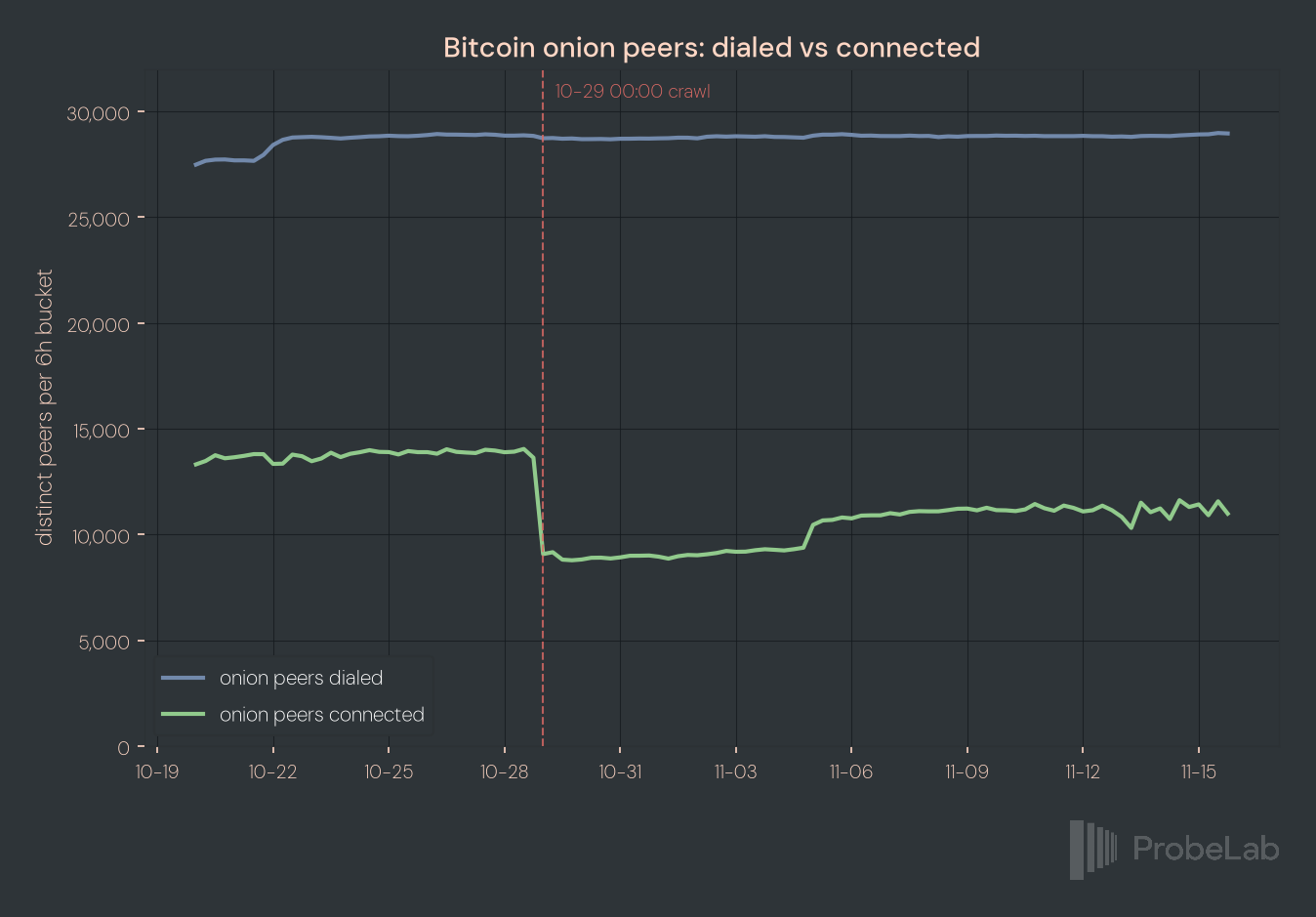
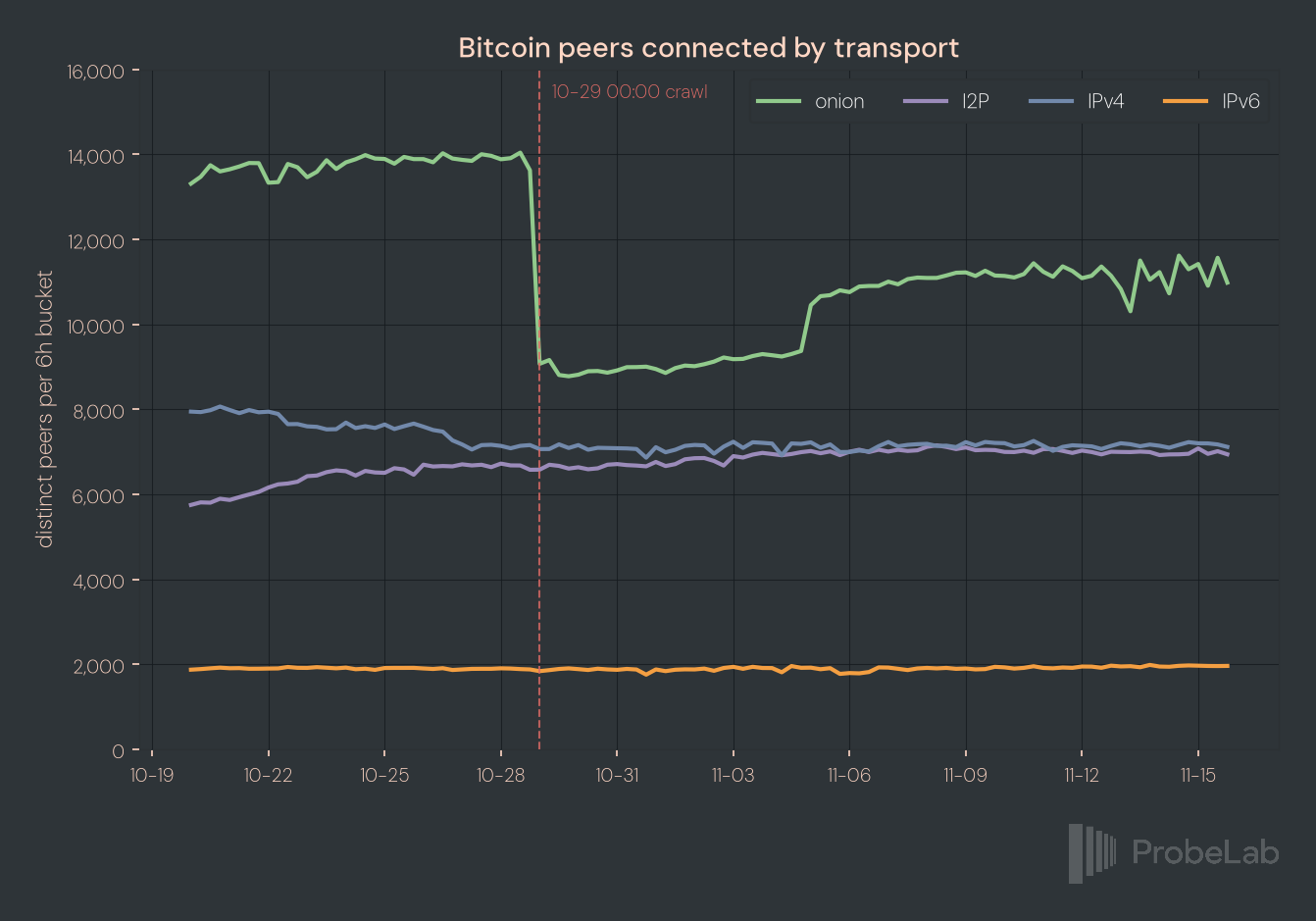
On the 29th of October, Bitcoin nodes reachable as Tor onion services dropped by a third in our network data. Tor's own metrics show a large spike in relay clients over the same days which is apparently considered a DDoS attack on the Tor network. Nodes on IPv4, IPv6 and I2P did not change.
Quick recap of what we measure
Our flagship crawler, Nebula, crawls the Bitcoin P2P network about every six hours. It collects node addresses from peers and then dials each address. Onion addresses are dialed through a set of local Tor proxies. A node counts as connected when the dial succeeds.
What happened on the 29th of October
| Metric | 10-28 18:00 crawl | 10-29 00:00 crawl |
|---|---|---|
| Onion peers connected | 13,627 | 9,071 |
| Onion peers dialed | 28,845 | 28,733 |
On the 29th of October the number of peers we could connect to via Tor dropped from ~13.6k to 9.1k while the peers we tried to dial stayed almost constant. The step happened between the above two crawls, a drop of about 33%.
Looking at the other available transports IPv4, IPv6 and I2P we see that these three stay within a few percent through the drop. Only Tor changed.
Errors on onion dials
We compared failed onion dials in the 12 hours before 20:00 on 10-28 with the 12 hours after.
| Error | Before | After |
|---|---|---|
tor_onion_service_not_found |
23,472 | 32,855 |
tor_onion_service_connect_failed |
679 | 2,659 |
tor_stream_closed |
2,523 | 769 |
tor_proxy_error |
1,841 | 1,859 |
tor_proxy_error is flat, so the local Tor proxy was not the problem. Connect failures rose by about 4x.
Comparison with Tor Metrics
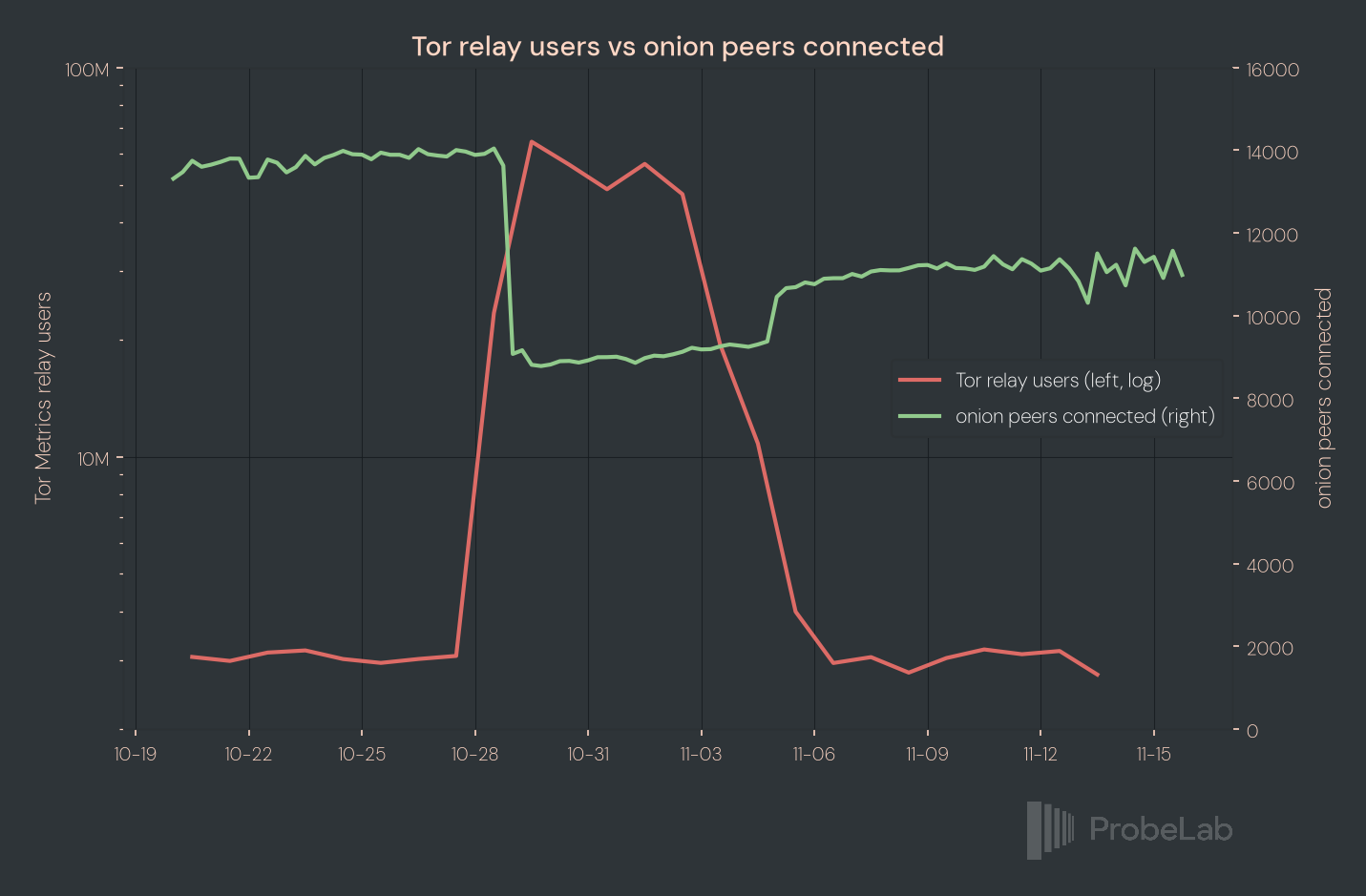
Tor Metrics estimates relay clients from directory requests. The estimate was about 3M per day until the 27th of October 2026. It then rose to 23.4M on the 28th and 64.5M on the 29th, stayed between 47M and 57M through the 2nd of November, and was back to about 3M by the sixth.
The Tor Project released 0.4.9.17 on the 13th of November as a response to an ongoing DDoS that is overwhelming relays with client circuits. The release note does not give a start date. The timing of the client spike matches our drop.
Who came back
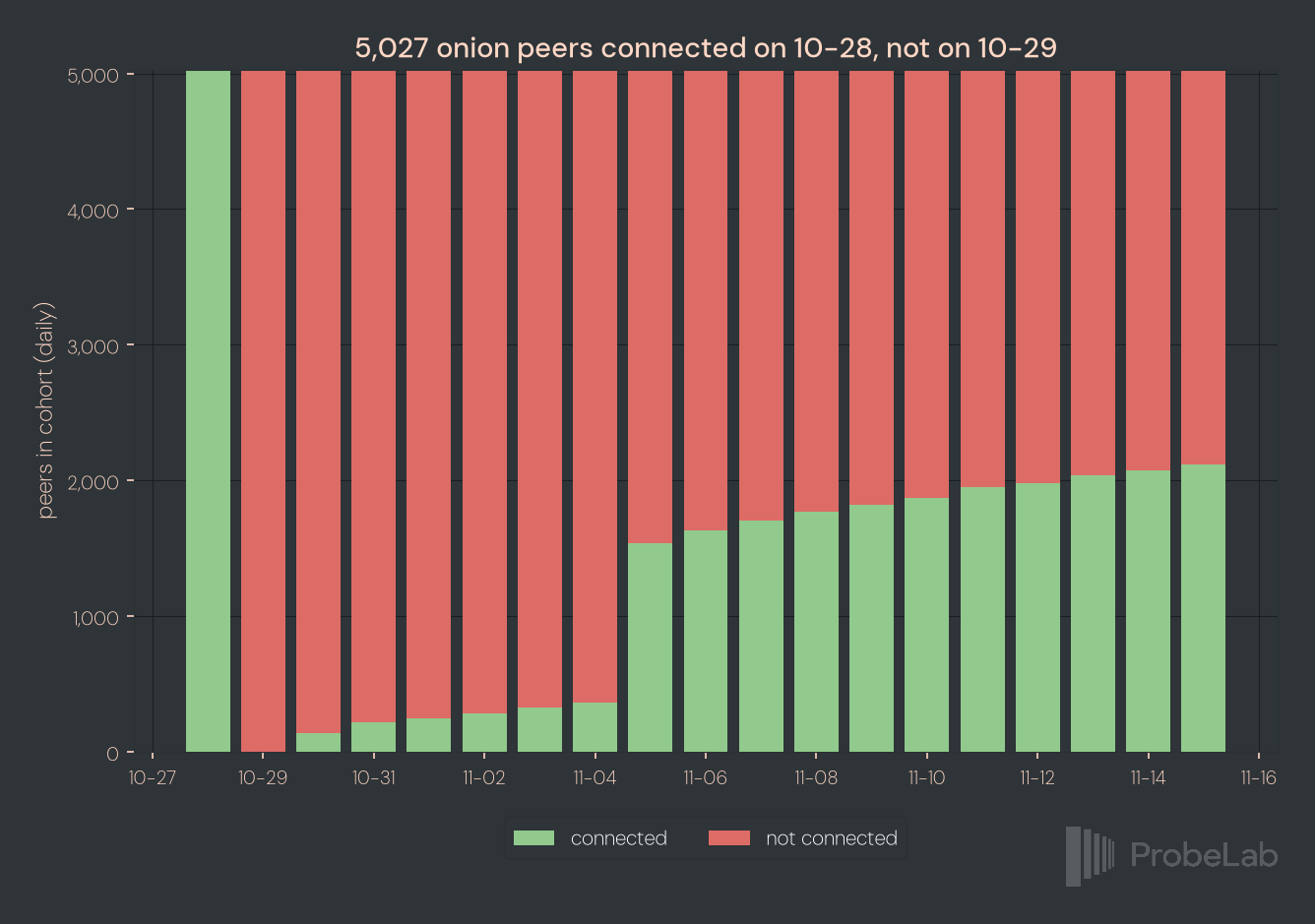
We continued to check who of the peers that were evicted from the Bitcoin network actually came back. We took the onion peers connected on 28th of October before 18:00 as a baseline.
| Group | Peers |
|---|---|
| Baseline | 14,525 |
| Still connected on 10-29 | 9,498 |
| Lost on 10-29 | 5,027 |
| Not in baseline, connected on 10-29 | 361 |
Of the 5,027 lost peers:
| Status on 13th + 14th of November | Peers |
|---|---|
| Connected again | 2,126 (42%) |
| Still dialed, not connecting | 2,898 (58%) |
| No longer in the crawl | 3 |
Only 3 of the lost peers disappeared from the address set.
On 13th + 14th of November, 12.5k onion peers connected. 1.7k of them were not in the baseline. Daily onion peers that we could connect to rose from 9.9k on October 29th to 12.2k on November 14th, against 14.7k before the drop.
The recovery has one step. Onion peers connected went from 9.3k to 10.5k around November 5th. In the lost cohort, connected peers went from 361 to 1.5 during the same time.
What we do not know
- Why the failures moved from
not_foundtoconnect_failed. We have not confirmed whether hidden-service directories, introduction points or rendezvous circuits were the bottleneck. Tor-side data would be needed. - Whether the 2,898 peers still failing are affected by the same problem, offline, or rotated their onion address.
- Our crawls run every 6 hours, so the start time is known only to within a crawl interval.
Conclusion
On the 29th of October 2026, onion-reachable Bitcoin nodes fell by about a third in our collected metrics while the number of onion addresses we dialed stayed constant. IPv4, IPv6 and I2P peers did not change. The drop starts the day the Tor Metrics relay-user estimate rises from about 3M to 64.5M. Bitcoin node recovery stepped on November 5th, while simultaneously the Tor relay-user estimate fell from 10.8M to 4.0M. 2.1k of the 5k lost Bitcoin peers (42%) have reconnected since. The timing of our drop and recovery matches the Tor relay-client spike. We have no Tor-side data on which part of the hidden-service path failed, and 2.9k of the lost peers still do not connect which requires further investigation.
Related Posts

160 Dials: How Two go-libp2p Defaults Halved Our View of Polkadot
Our Polkadot crawls reached about half of the reachable network, and a different half every time. The cause was two dial limits in go-libp2p. We explain how they work, how we found them, and how to size them.

Introducing ProbeLab Sonar
Sonar is a free lookup tool for p2p node operators and protocol teams. Paste a PeerID, an ENR or a Multiaddress and see live probe results next to years of crawl history. Available today in beta.

Security Audit Report: Optimum Gateway
A security and code audit report on the Optimum Gateway by the ProbeLab team.