Walrus vs. Filecoin vs. IPFS vs. S3: What ProbeLab's Storage Audit Actually Found
Decentralized storage networks emerged the last few years as an alternative to traditional solutions where one company holds the keys to your data. Until now, there's been no independent, apples-to-apples comparison on how these systems actually perform against each other, let alone against the centralized cloud storage most of the internet still runs on.
ProbeLab set out to close that gap. Over several weeks in mid-2026, we ran identical, continuous probes against four storage systems — Walrus, Filecoin, IPFS, and Amazon S3 — measuring upload and download throughput, time to first byte, how long each system takes to commit to actually keeping your data, and how often it fails to. This study was commissioned by the Walrus Foundation and presents an honest, unbiased view of the findings.
What we compared
Walrus is a decentralized blob store coordinated by the Sui blockchain. Storage nodes hold erasure-coded fragments of each blob, and an on-chain certification proves the network has committed to keeping it available, making data a portable, programmable, and verifiable asset.
Filecoin has independent storage providers take custody of data and periodically prove on-chain that they still have it. Filecoin has been tested here through its newer Warm Storage pathway.
IPFS is a peer-to-peer content-addressed network with no persistence guarantee and no payment layer. Your data survives only as long as someone chooses to keep serving it, so it’s more of a content addressing and delivery system, rather than a storage solution.
Amazon S3 is the well-known centralized baseline. One company, one set of servers, and a durability guarantee you take on faith rather than on-chain proof.
Methodology
Every system was put through the same four-step cycle, every 15 minutes, at three file sizes (100 KB, 10 MB, and 100 MB), from a single AWS region: generate a random file, upload it and time how long the system took to durably commit to it, download it back and time the first and the last byte, and verify the bytes match. We built dedicated probes for each system (and adapted the Filecoin ecosystem's own dealbot tool) to keep the comparison as fair as the systems' very different designs allow. Where a metric genuinely doesn't translate, e.g., in IPFS's case, where "upload" is just a local disk write, not a network transfer, we make an explicit note, rather than force a number that would mislead.
Key Takeaways
Centralized systems lead on raw speed - but speed is only one axis. S3 leads on nearly every performance axis: uploads and downloads are fastest, time to first byte is a flat ~27 milliseconds regardless of file size, and committing to storage is just the write acknowledgment. That's the tradeoff global decentralization pays for spreading trust across independent parties instead of one company's word.
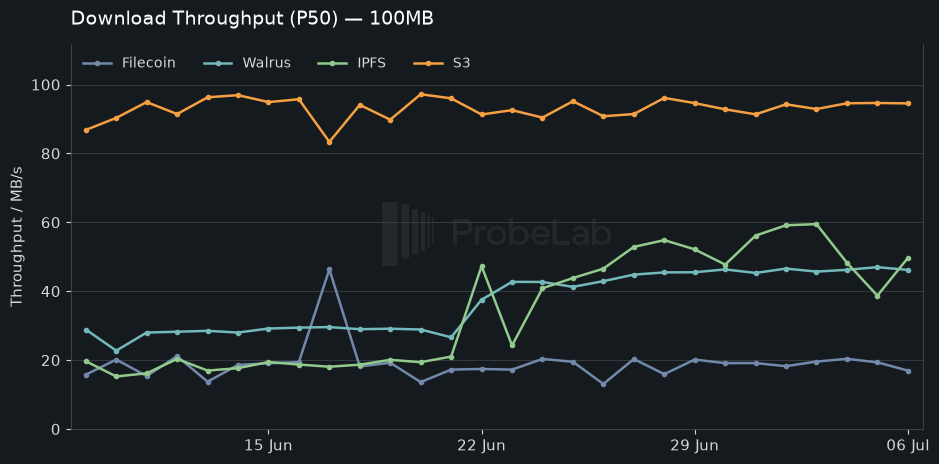
Among the decentralized systems, throughput and reliability don't move together. Walrus is the strongest bulk performer at scale: 39 MB/s median download at 100 MB, 2.4x slower than S3 and ahead of both competitors. Walrus is also by far the most consistent, with tight day-to-day variance, supporting its claim to be the data platform built for the demands of AI. Its higher time to first byte (TTFB) is a direct consequence of this design: the aggregator reconstructs the full erasure-coded blob before returning any bytes, so TTFB rises from under a second at 100 KB to 2.6 seconds at 100 MB, but the object then arrives intact and verified. Storing a blob end to end - upload, erasure-coding and on-chain certification - takes about 8.8 seconds, a one-time cost that buys a publicly verifiable commitment to keep the data available. Walrus TTFB can further improve through an aggregator that has streaming read API. Through this avenue the aggregator does not need to wait for reconstructing the blob. We have intentionally not used the API for the purposes of this study, so that we measure the base performance of Walrus.
Filecoin is the volatile one. Its storage failure rate, i.e., the share of upload attempts that never produce a durable, on-chain-confirmed commitment, swung from 50–70% in early June down to nearly 0% for a few days around June 20–22, then climbed back up to almost 90% by early July. Averaged across the whole window that's roughly 38%, meaning over a third of storage attempts simply didn't land. When a deal does succeed, retrieval works about 99% of the time, but that 99% is measured only over the deals that survived the storage step, not the full population of attempts.
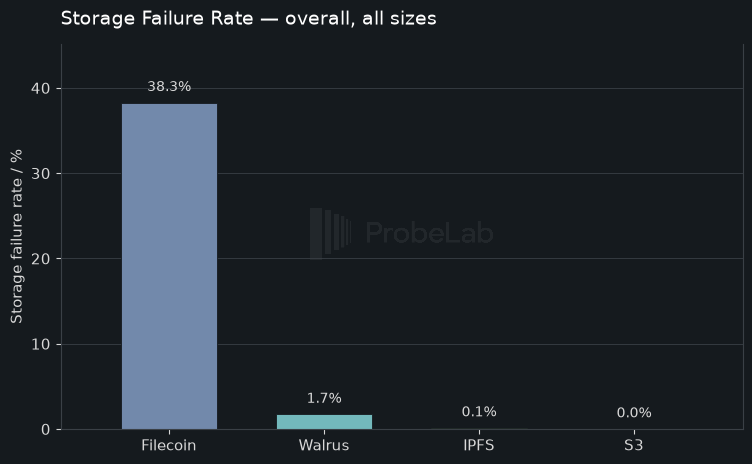
IPFS presents near-zero storage failures, essentially 100% retrieval success, competitive throughput. But the numbers come with an asterisk because we measured it differently from the others, by necessity. IPFS has no storage providers to probe, so we supplied both ends: one node seeded freshly generated content and announced it, and a second node found it and fetched it. Discovery was a real network operation. The transfer was not as both nodes ran in us-east-1 alongside every other probe in the study. So the IPFS throughput and TTFB figures can only be read as a same-region floor. The discovery timings, however, are directly comparable to the other systems under test.
IPFS also has no persistence guarantee and no payment model at all; nothing obligates any node to keep your data around.
Cost is closer than the performance numbers suggest — all within less than an order of magnitude of each other:
| System | Store cost (100 MB / 30 days) | Basis | Retrieval cost |
|---|---|---|---|
| Walrus | $0.0023 | Modeled (published rates) | Free |
| S3 | $0.0023 | Modeled (published rates) | ~$0 in-region |
| Filecoin | $0.0010 | Modeled (published rates) | Unmetered (as tested) |
| IPFS | — | No storage market | — |
All four costs are modelled from published rates. For Walrus we used current pricing at the time of the study, but Walrus storage prices have since dropped, hence it's now based on modelling from published rates. For Filecoin, modelling was necessary because Filecoin's storage is paid by depositing USDFC into a payment contract that streams charges to providers over time, and its per-deal operations run under session keys rather than the funding wallet, so no per-file on-chain cost is observable.
It’s worth flagging that Walrus also has an extra ~64 MB of metadata per blob/quilt (batch of blobs) plus gas fees — and the experiment deliberately avoided Walrus's Quilt batching feature, which bundles many small files together and can almost eliminate the metadata overhead, in order to keep the comparison like-for-like. So the Walrus figures here represent close to the worst case for small files, not what a production integration using Quilt would actually pay.
Results
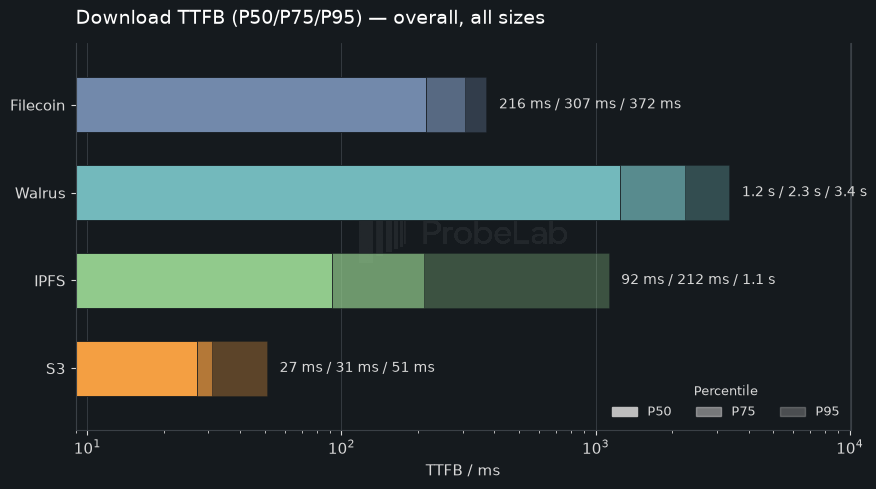
Time to first byte (TTFB) is flat for S3 and Filecoin, and scales with blob size for Walrus
Time to first byte (TTFB) measures how fast a system starts streaming data back. S3 is flat at ~27 ms regardless of file size. Filecoin is also flat, around 216 ms. IPFS has a low median (49–135 ms), but a heavy tail, since some retrievals resolve instantly over Bitswap, while others fall back to a slower DHT walk. Walrus comes in last: its aggregator has to reconstruct the entire erasure-coded blob before releasing the first byte, so its TTFB is really a whole-blob decode time that grows with file size — this is the flip side of the bulk-throughput strength it showed above.
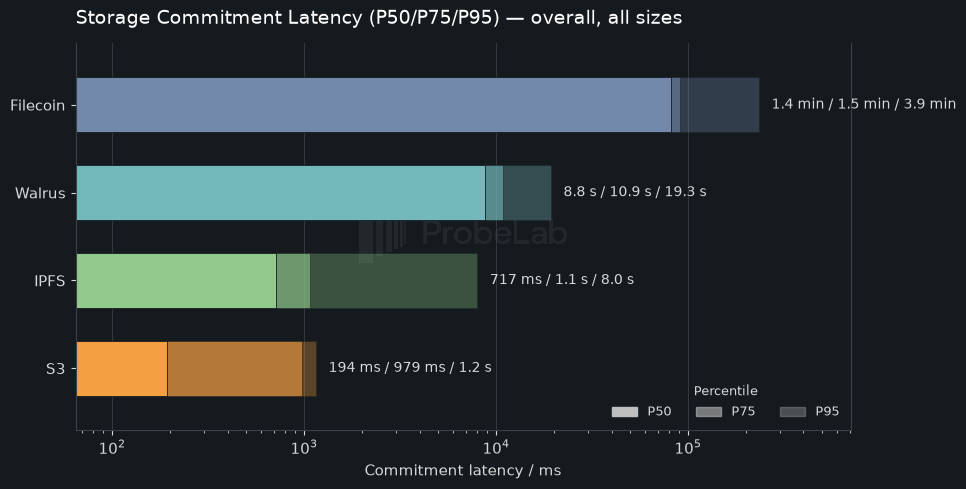
Walrus provides an on-chain commitment in 8.8 seconds, the faster of the two verifiable systems
This is the time from starting an upload to the system's first verifiable proof that the data is durably held. Ranked by raw number, S3 is fastest (its "commitment" is just the upload acknowledgment), then IPFS (an unverified provider announcement), then the two systems with a real on-chain guarantee: Walrus at about 8.8 seconds and Filecoin at about 1.4 minutes. The ranking rewards the weaker guarantees — S3 and IPFS look fast because neither is proving anything independently.
The Walrus team is working on an improvement (in testnet environment), where tail handling is detached and does not impact upload completion, and reported on-chain commitment as low as 6 seconds. But this has neither been tested, nor verified as part of this study.
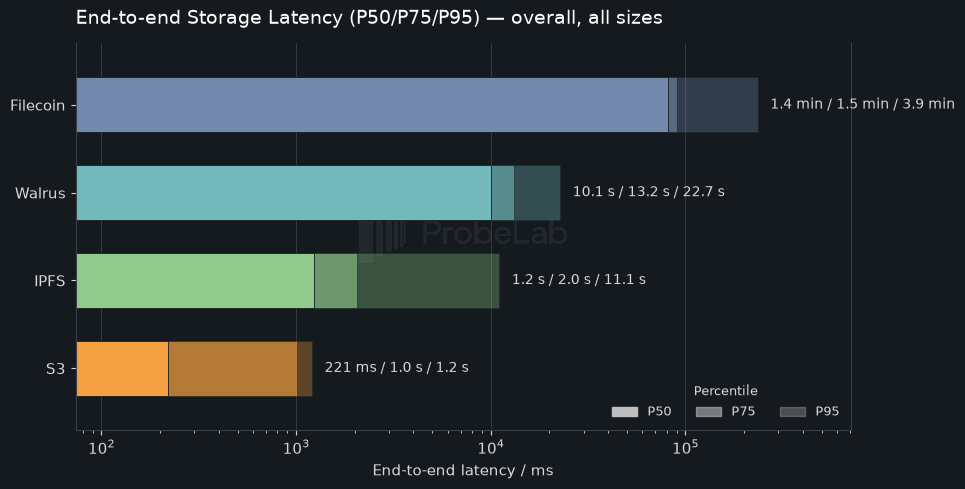
End-to-end latency is dominated by the commitment step on every platform
This is the full client experience: from upload to durable commitment, plus the time to retrieve the first byte back, with the study's scheduling artifacts stripped out. The ordering tracks storage commitment latency almost exactly, since that leg dominates the total on every system; the only place retrieval adds a visible chunk is Walrus at 100 MB, where its ~2.6 s reconstruction time becomes a meaningful share of the total.
Conclusion
No single system wins across the board — each makes a different tradeoff. Here's how the four compare across the metrics that matter most, rated independently column by column so a system's throughput doesn't get blended with its responsiveness or its durability guarantee:
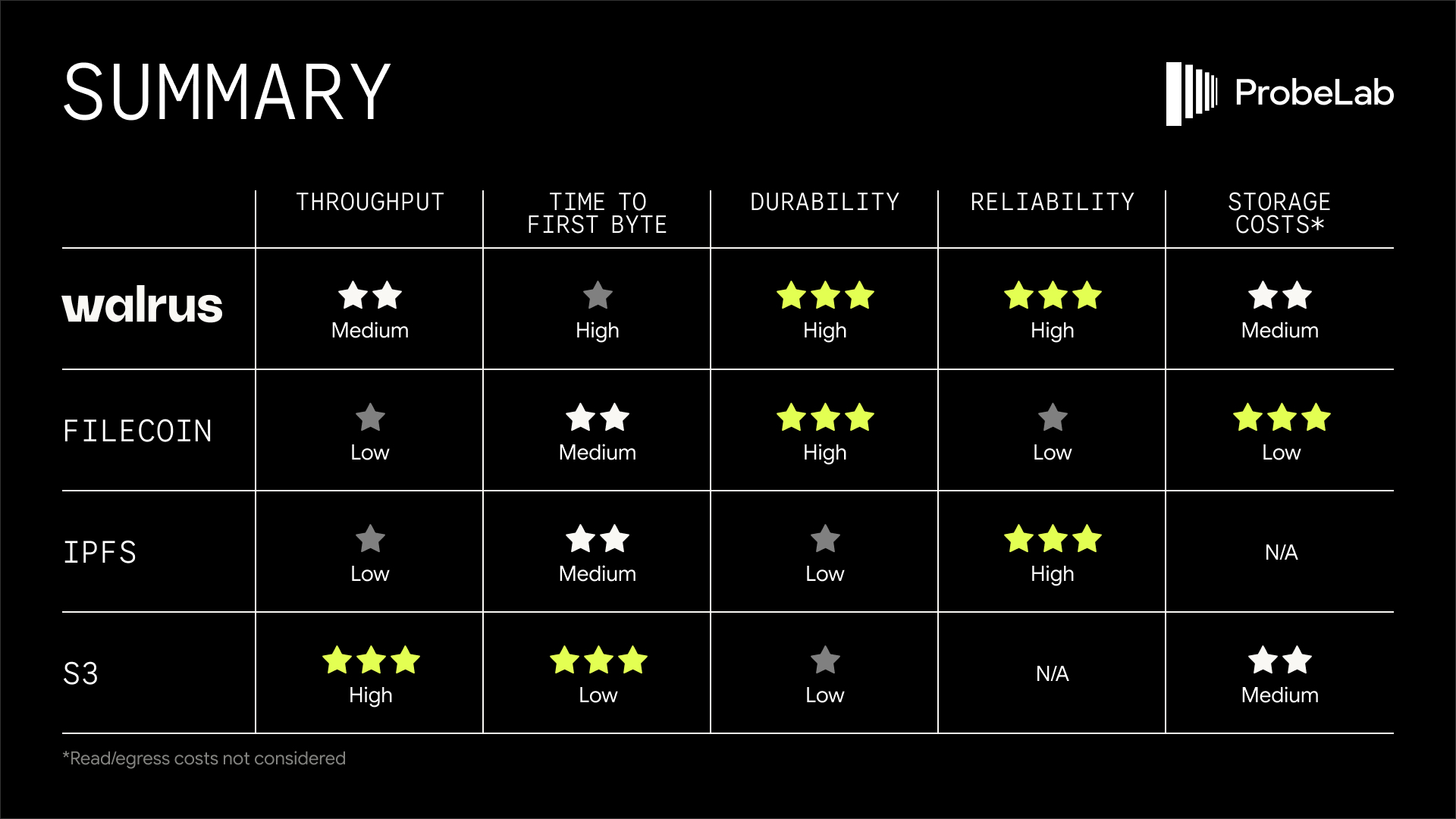
Clearly, there's no single winner — it depends on which of these tradeoffs matters most for what you're building.
- S3 gives you speed and a low, simple cost, backed only by trust in one company.
- Walrus gives you the strongest, most consistent bulk performance of the decentralized options and an independently verifiable durability guarantee, at the cost of slower time-to-first-byte and a real (if fixable) small-file cost premium.
- Filecoin is the cheapest of the decentralized systems and has an unmetered retrieval path, but its reliability at the storage step was, over our measurement window, its biggest liability.
- IPFS is fast and cheap to participate in but isn't really a storage service at all — it's a delivery network with no one obligated to keep your bytes.
If you're building something that needs a verifiable guarantee that your data will still be there next month, this audit shows Walrus and Filecoin actually deliver on-chain proof that S3 can't — Walrus more consistently, Filecoin more cheaply.
This study was commissioned by the Walrus Foundation and conducted independently by ProbeLab.
Related Posts

Can libp2p punch through NATs?
How efficient is libp2p’s DCUtR protocol in connecting actual peers directly?
Optimistic Provide: How We Made IPFS Content Publishing 10x Faster
How a statistical approach cut IPFS content publishing times by over one order of magnitude.

IPFS Gateway Performance Measurements
The ProbeLab team has been busy building new IPFS Gateway performance measurements