— On stage

Talks

Conference talks and presentations from the ProbeLab team.

2021
Thumbnail for Measuring the Web3.0 Stack
Web3 Summit

Measuring the Web3.0 Stack

Yiannis Psaras

Yiannis Psaras introduces ProbeLab's systematic measurement program for the Web3 stack, built around the Nebula crawler that snapshots the IPFS DHT roughly every 30 minutes across a probes/storage/processing architecture. The talk reports IPFS DHT churn comparable to early BitTorrent, with around 60% of server peers staying online for 1.5 hours or less and 80% for under three hours, and classifies the network into roughly 14% always-on, 85% dangling, and 0.6% always-off nodes. Infrastructure attribution shows only about 13% of nodes run on known cloud providers (DigitalOcean, AWS, Azure) while the remainder run on home machines or unidentified hosts, and a Hong Kong-based correlation analysis finds no significant day/night uptime pattern. Psaras then breaks down end-to-end content lifecycle latency into DHT walk and put phases for publishing and retrieval, and shows agent-version breakdowns of failed provider record puts (around 36% on go-ipfs, 31% on Hydra boosters) as a starting point for targeted debugging.
Watch
Thumbnail for Introducing Peer Copy - A fully Decentralized File Transfer Tool
IFIP DI2F

Introducing Peer Copy - A fully Decentralized File Transfer Tool

Dennis Trautwein

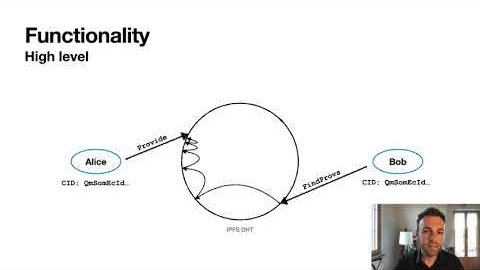
In this short conference presentation from IFIP Networking 2021, Dennis Trautwein introduces Peer Copy (pcp), a fully decentralized peer-to-peer file transfer tool built on libp2p and developed with co-authors Moritz Schubotz and Bela Gipp. The talk explains how pcp lets any two parties exchange a file using only a short, memorable sequence of words drawn from the BIP39 wordlist — no accounts, no relay servers, and no central rendezvous service. Trautwein walks through the two-stage protocol: peer discovery happens via multicast DNS when both endpoints sit on the same local network and via provider records in the InterPlanetary File System's distributed hash table when they are separated by the public internet, after which the shared word sequence is fed into a password-authenticated key exchange (PAKE) to derive a strong session key that authenticates the peers and encrypts the transfer. He contrasts this design with established tools like croc and magic-wormhole, which still depend on operator-run rendezvous infrastructure, and presents measurements showing that the fully decentralized approach can match the performance of these centralized alternatives while removing single points of failure and trust.

Watch